
Cat6 or Cat6a. The cables look almost identical, the price gap sounds small on the reel, and most explanations online either oversell Cat6a as essential or skip past the actual differences.
Here's the honest version, from the people who terminate and test both every week. Real speed and distance differences, where Cat6a genuinely earns its price, and where it doesn't.
See our structured cabling service if you're ready to plan an installation, or keep reading for the comparison first.
Cat5 vs Cat5e vs Cat6 vs Cat6a at a glance
Before comparing Cat6 and Cat6a specifically, it helps to see the whole family side by side. Each generation raised the bandwidth ceiling and tightened manufacturing tolerances to cut interference between the twisted pairs inside the cable.
| Standard | Max speed (100m run) | Max speed (shorter runs) | Typical use today |
|---|---|---|---|
| Cat5 | Effectively obsolete | n/a | Legacy installs only |
| Cat5e | 1 Gbps | n/a | Still common, budget installs |
| Cat6 | 1 Gbps reliably; 10 Gbps only over shorter distances | 10 Gbps up to roughly 37 to 55m | General home and office networking |
| Cat6a | 10 Gbps | 10 Gbps at the full 100m | Longer-term headroom, PoE-heavy, or performance-critical runs |
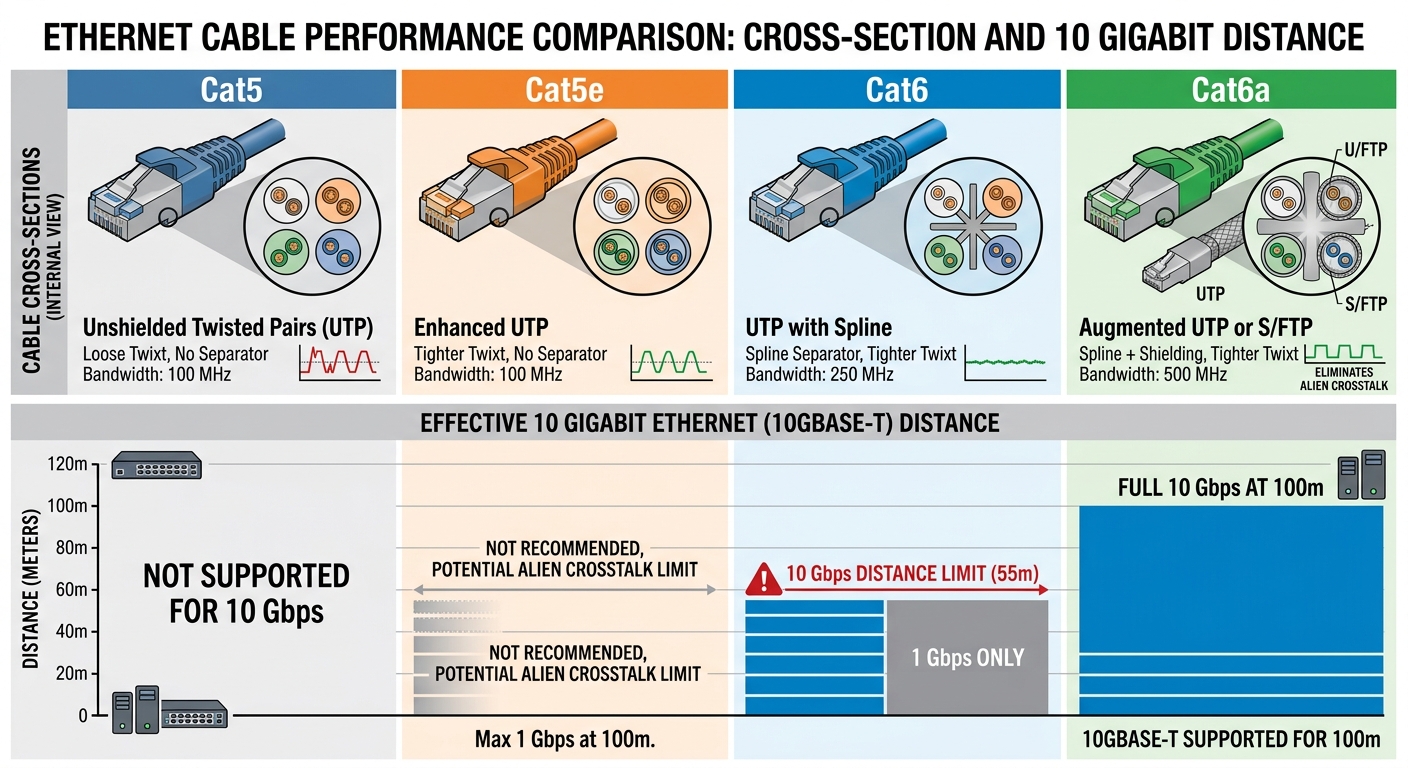
The higher the cable category, the further a 10-gigabit connection travels before it drops back to gigabit speeds.
A cat5 vs cat6 comparison isn't really a fair fight. Cat5 can't reliably handle gigabit speeds at all, and it's rarely installed new today. Cat5e closed that gap for 1 Gbps, but it wasn't built with 10-gigabit speeds in mind, so a cat 5 ethernet vs cat6 comparison and a Cat5e vs Cat6a comparison are answering different questions. The real decision most people are actually weighing is Cat6 against Cat6a.
Cat6 vs Cat6a: the real difference
Cat6a carries a full 10-gigabit connection over the entire standard 100 metre run. Cat6 only does that over roughly a third to half that distance, then drops back to gigabit speeds beyond it.
Cat6a reaches that longer 10-gigabit range through tighter internal twisting and, in most cables, extra shielding to cut alien crosstalk, the interference that comes from neighbouring cables bundled together in the same containment. That's also why Cat6a cable is thicker and stiffer than Cat6, which matters when you're routing it through tight conduit or an existing wall cavity.
In practical terms, when comparing cat6a vs cat6:
- Speed at typical run lengths. Most home cable runs sit well under Cat6's 10-gigabit distance limit, so the practical speed difference is often small.
- Headroom for later. Cat6a gives you room for 10-gigabit switches and equipment as they get cheaper and more common, without re-cabling later.
- PoE performance. Higher-power PoE standards generate more heat inside a bundled cable run. Cat6a's shielding and thicker conductors handle that better over long, densely bundled runs, which matters more in commercial installs than a typical home.
- Cost and installation. Cat6a cable, connectors and patch panels all cost more, and the stiffer cable is less forgiving to route and terminate neatly.
Does upgrading to Cat6a make your internet faster?
Usually not. Your internet speed is set by your broadband connection, not the cable inside your walls. Most UK residential broadband runs well under 1 Gbps, comfortably inside what Cat6 already handles.
Cat6a mainly helps traffic that stays inside your own network: large transfers to a NAS drive, local backups, or moving data between a multi-gig switch and a workstation. If none of that applies to you, Cat6a won't make streaming or video calls smoother. The bottleneck sits at the broadband connection or the Wi-Fi hop, not the cable.
Cat 5e vs Cat 6a: is it even a fair comparison?
Not really, and this is where a lot of buying decisions go wrong. Cat5e tops out at 1 Gbps and was never designed for 10-gigabit performance. Cat6a is rated for a full 10 Gbps over the entire 100 metre run.
Jumping from Cat5e straight to Cat6a is a significant upgrade, not an incremental one. If you're already re-cabling and weighing Cat5e against Cat6a specifically, the practical question usually isn't "is Cat6a better" (it is), it's whether you need 10-gigabit headroom at all, which is really the Cat6 vs Cat6a question in disguise.
Is there such a thing as "Cat6e"? Cat 6a vs 6e cable explained
You'll sometimes see "Cat6e" cable advertised. There is no official Cat6e standard recognised by the bodies that define these specifications, TIA/EIA and ISO/IEC. "Cat6e" is an unofficial marketing term some manufacturers use, generally describing an upgraded version of Cat6, but because it isn't a certified standard, the actual specification can vary between manufacturers.
If a cable is genuinely built and tested for 10 Gbps at the full 100m, it should be labelled and certified as Cat6a, not "Cat6e." Treat any cat 6a vs 6e cable comparison with caution: you're comparing a certified standard against a term with no fixed definition.
Shielded (STP) vs unshielded (UTP): do you actually need it?
Both Cat6 and Cat6a come in shielded (STP) and unshielded (UTP) versions, and this trips people up almost as often as the category question itself.
Shielding adds a layer of foil or braided screening around the cable to block electromagnetic interference from nearby sources: power cables, fluorescent lighting ballasts, industrial equipment, lift motors. Unshielded cable relies on the twisted-pair design alone to cancel out interference, which is usually enough in a typical home or office.
In practice:
- Most homes don't need shielded cable. Standard UTP is easier to terminate, more flexible to route, and cheaper. Interference isn't a significant issue in a typical domestic environment.
- Shielded cable earns its keep when a run travels alongside mains power cabling for any distance, in commercial comms rooms with dense cable bundling, near industrial machinery, or anywhere with unusually high electrical noise.
- Shielded cable needs proper earthing to actually work. An improperly grounded shielded run can perform worse than unshielded, not better. This is an easy detail to get wrong on a DIY install.
If you're not sure whether your routing has an interference risk, ask an installer to assess it rather than defaulting to shielded cable just in case. It adds cost and installation complexity most homes never need.
When Cat6 is enough
Cat6 is a solid choice for:
- Home networks with relatively short cable runs, since most domestic runs fall well inside Cat6's 10-gigabit range anyway
- Standard gigabit internet connections, which cover the vast majority of UK residential broadband
- Budget-conscious projects where every run doesn't need 10-gigabit headroom
- Wi-Fi access point backhaul, since a typical home access point is unlikely to need more than 1 to 2.5 Gbps for years to come
When Cat6a is worth it
Cat6a earns its higher cost when:
- Cable runs are long and you want guaranteed 10-gigabit performance across the full distance, not just the shorter runs
- You're cabling a business, server room, or data cabinet where multiple bundled cables make alien crosstalk a real factor
- You're installing higher-power PoE devices over longer runs
- You want genuine headroom for later and don't want to reopen finished walls or floors again in five years
Solid-core vs stranded cable: a detail retailers often skip
There's a second choice hiding inside both the Cat6 and Cat6a decision: solid-core versus stranded cable. It's less well known than the category debate, but it matters for anyone planning a permanent installation rather than buying a single patch lead.
Solid-core cable uses a single solid copper conductor per wire. It carries a signal further with less loss, but it's stiff and not built for repeated flexing. This is what belongs inside walls, floors and ceilings for permanent structured cabling runs.
Stranded cable uses several thin copper strands per wire, which makes it more flexible and durable for repeated movement. This is what belongs in short patch leads, from the wall outlet to your device, or from the patch panel to the switch, where the cable gets handled.
Using stranded cable for a long permanent in-wall run, or solid-core for a patch lead, is a common shortcut that causes reliability issues later. It's easy to get wrong buying reels online, and it's exactly the kind of detail a proper structured cabling installation gets right by default.
What does the price difference actually look like in the UK?
The raw cable cost gap is smaller than people expect. Cat6a cable typically costs somewhere around 10 to 40% more than Cat6 per metre or per reel, depending on the manufacturer and whether it's shielded.
The bigger gap shows up once installation, termination and testing are included. Cat6a is thicker and stiffer, so routing, terminating and testing it takes more care and more time. That extra labour adds more to the total than the raw material cost alone, and it grows with every run that has to be done to a certified standard.
For a handful of runs in a typical home, that difference rarely decides the outcome. It matters more at scale: a full office fit-out with dozens of data points feels the Cat6a premium far more than a house with a few runs.
How do I know what cable I already have?
If you're extending an existing network rather than starting fresh, check what's already installed before assuming you need an upgrade. The cable category is usually printed directly on the cable jacket. Look for text reading "CAT5E," "CAT6," or "CAT6A" along the cable itself, wherever you can access it: a patch panel, a wall outlet, a loft run.
Bend radius and routing: why Cat6a isn't a drop-in swap
Cat6a's thicker build isn't just a cost difference. It changes how the cable behaves during installation. It has a larger minimum bend radius than Cat6, meaning it can't turn as tight a corner without risking damage to the internal twisted pairs.
In a new build with generous conduit, that's rarely an issue. In a period property with narrow existing wall cavities, tight loft access, or a cable route already sized for a thinner cable, it can mean Cat6a simply won't fit where Cat6 would. The physical route sometimes constrains the choice as much as the performance specification does.
Our approach
For most residential structured cabling projects, we scope the cable standard around the actual run lengths and intended use, not around whichever option costs the most. For business installations, data cabinets, and anywhere PoE-heavy equipment is involved, Cat6a is usually the sensible baseline. Every run we install gets tested and certified before handover, whichever standard is specified.
If you're not sure which is right for your project, that's what a site survey is for. Get a free quote audit and we'll recommend the standard that fits your setup, not the one that costs more.
Frequently asked questions
Is Cat6a worth it over Cat6 for a home network?
For most homes, Cat6 is enough. Typical run lengths stay well within Cat6's 10-gigabit range, and most UK broadband connections don't exceed 1 Gbps. Cat6a earns its extra cost mainly through longer-term headroom, longer runs, or heavier PoE use.
Does upgrading to Cat6a make my internet faster?
Usually not. Your internet speed depends on your broadband connection, not the cable inside your home, and most UK broadband sits well under 1 Gbps, comfortably within what Cat6 handles. Cat6a mainly benefits traffic that stays inside your own network, like NAS transfers or local backups.
What's the difference between Cat5e and Cat6a?
Cat5e is rated for 1-gigabit speeds and wasn't designed with 10-gigabit performance in mind. Cat6a is rated for 10-gigabit speeds over the full 100 metre run, with tighter twisting and extra shielding to cut interference. Cat6a is a significant step up, not an incremental one.
Is a Cat6a ethernet cable worth buying for a new install?
It depends on the run and the use case. For long runs, business installs, heavy PoE, or genuine headroom for later, yes. For short home runs on a standard broadband connection, Cat6 usually does the job for less money.
Is "Cat6e" a real standard?
No. There's no officially recognised Cat6e standard from TIA/EIA or ISO/IEC. It's an unofficial marketing term. If you need 10-gigabit performance over the full run length, look for cable certified as Cat6a.
Can Cat6 handle gigabit internet?
Yes. Standard Cat6 comfortably handles gigabit (1 Gbps) speeds over the full 100 metre run, which covers the vast majority of UK residential internet connections.
Do I need Cat6a for a home office or garden office run?
Not usually, unless the run is unusually long or you specifically want 10-gigabit headroom for later. Cat6 is normally enough for a garden office connection. The bigger factor for a garden office is usually getting a dependable hardwired run there at all, not which cable category you use.
How do I check what cable category is already installed in my home?
The category is usually printed directly on the cable jacket. Look for text reading "CAT5E," "CAT6" or "CAT6A" wherever you can access the cable: a patch panel, a wall outlet, a loft run.
Explore our structured cabling service or get a free quote audit for your project.